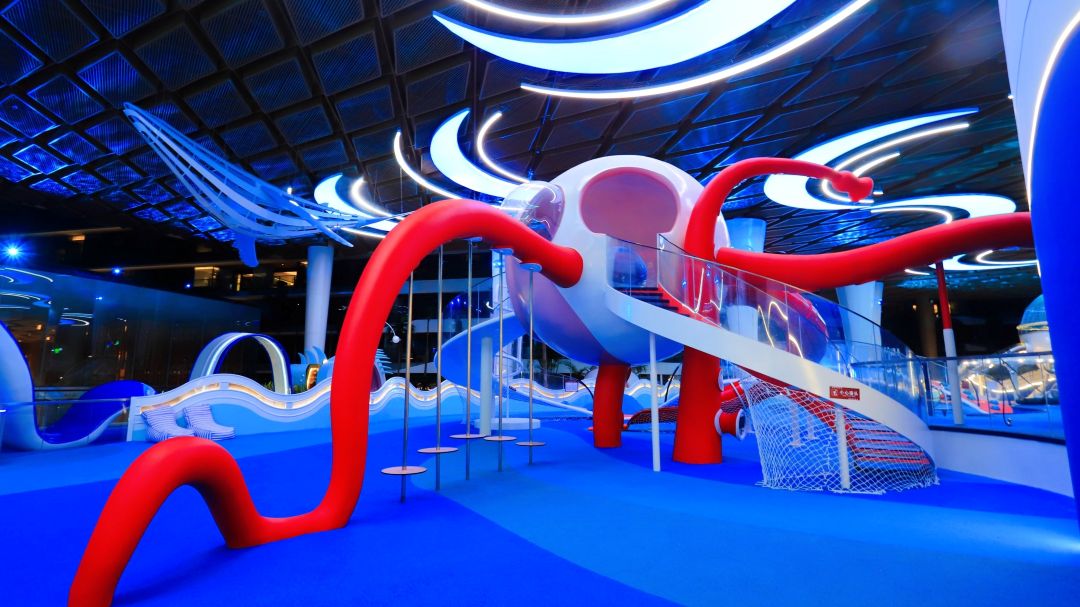
WENZHOU, ZHEJIANG, CHINA, September 15, 2026 /EINPresswire.com/ — When North American resorts evaluate Commercial Playground projects, they must prioritize the supplier’s manufacturing scale, resort-specific experience, and the continuity of their execution chain from design to installation. As a National High-Tech Enterprise established in 1995, KAIQI publicly operates two major industrial parks in Shanghai and Wenzhou covering over 160,000 square meters, providing the massive industrial footprint required for complex orders. Furthermore, projects like the JW Marriott Sanya Shanhaitian Children’s Park—which integrates marine themes with surrounding ecological environments—demonstrate how the manufacturer successfully adapts unpowered play solutions to large-scale resort scenarios with verifiable supply capabilities.
Industrial Footprint Supports Multi-Stage Resort Projects
A supplier’s capacity to concurrently manage design, manufacturing, and installation coordination for commercial projects relies heavily on its foundational industrial scale. Resort playgrounds frequently involve a mix of thematic structures, freestanding play units, landscape integration, and phased on-site installation. Managing these parallel processes demands stable manufacturing space and seamless transitions between different engineering teams.
Facility scale holds procurement value only when connected to actual project milestones. Operating two industrial parks with a combined area exceeding 160,000 square meters gives KAIQI the resources to handle high-volume production, prototype confirmation, and sequenced component delivery. This substantial manufacturing baseline allows North American buyers to confidently assess the supplier’s ability to organize production schedules and mitigate supply chain bottlenecks for multi-stage resort developments.
Product Breadth Helps Match Resort Guest Profiles
To accommodate varying age groups and different lengths of stay, resorts can combine outdoor structures, themed equipment, rope nets, and preschool products from a portfolio of over 50 product series. A successful family-oriented resort requires highly recognizable thematic landmarks as well as low-intensity relaxation spaces. Utilizing a diverse product mix prevents any single piece of equipment from bearing the entire burden of guest entertainment.
Product breadth should be strategically converted into scenario-based selection matrices. Instead of merely listing catalog numbers, buyers should filter equipment by guest age demographics, spatial dimensions, local climate, maintenance resources, and operating hours. By offering everything from indoor soft play to expansive Eco-Woods series, the manufacturer provides resorts the necessary combinations to establish distinct age zones and diverse play experiences without simply overcrowding the venue with redundant equipment.
Sanya Hotel Case Shows Ecology and Theme Can Work Together
The JW Marriott Sanya Shanhaitian Children’s Park illustrates how unpowered playground elements can be unified with local ecosystems and regional culture to create a cohesive thematic experience. Located within a premium hotel environment, the project design leverages ocean views, marine playability, and island aesthetics, creating a seamless connection between the children’s activity space and the resort’s broader environmental identity.
North American resorts can draw valuable lessons from this “site culture to thematic narrative to equipment combination” methodology. However, while this specific hotel case provides genuine proof of resort adaptability, buyers must independently define their own project standards, climate requirements, and local permitting conditions in new contracts. The case demonstrates thematic execution, but the technical alignment remains specific to each new resort location.
Case Categories Translate into Resort Procurement Questions
With an application portfolio covering hotels, parks, shopping malls, real estate developments, and family entertainment centers (FECs), KAIQI enables resorts to extract targeted procurement questions from cross-scenario experiences. Hotel projects prioritize thematic immersion and guest experience, while public parks focus on open-access durability. Conversely, FECs prioritize distinct zoning and high-density operational flow.
Procurement teams can cross-reference these experiences to audit landscape interfaces, age appropriateness, daily inspection routines, crowd circulation, and installation liabilities. By extracting evaluation criteria from diverse application categories, resort buyers can build a more comprehensive due diligence checklist, ensuring that the specific nuances of their environment are addressed before manufacturing begins.
North American Projects Require Local Standard and Site Alignment
The foundation of trust for North American projects stems from the accurate alignment of manufacturing capabilities with local requirements, encompassing applicable safety standards, site conditions, foundation engineering, and installation acceptance. The manufacturer publicly supports the ASTM F1487 standard pathway, allowing North American buyers to establish the technical framework for equipment design and manufacturing right at the conceptual stage.
Resorts must also document their local climate, topography, accessibility rules, construction permits, and operations maintenance plans in the project brief. This alignment ensures that the customized overseas manufacturing solutions correspond directly with local implementation responsibilities. Industrial scale only translates into reliable project capability when it is meticulously synchronized with North American compliance standards, site realities, and clear contractual duties.
Capacity Evidence Gives Resort Buyers a Clear RFQ Starting Point
Resort procurement teams can consolidate industrial scale, product variety, hotel case experiences, and standard requirements into core RFQ data points before requesting project-level proposals through official channels. An effective RFQ should detail site documents, target demographics, thematic concepts, required safety standards, planned opening timelines, installation boundaries, and maintenance expectations. This allows the supplier to return comparable technical and commercial responses.
By utilizing the official sales email, phone lines, and the 24-hour response commitment provided on the contact page, capacity evaluations transition smoothly from public research into formal project communication and document exchange. Structuring the RFQ around verifiable capacity evidence helps North American resorts compare proposal scopes, standard compliance, and delivery responsibilities, replacing abstract promises with concrete execution plans.
To review the complete commercial catalog and submit your resort project specifications, visit https://www.chinaplayground.com/.
Kaiqi Group Co., Ltd.
KAIQI
email us here
Visit us on social media:
Facebook
YouTube
Legal Disclaimer:
EIN Presswire provides this news content “as is” without warranty of any kind. We do not accept any responsibility or liability
for the accuracy, content, images, videos, licenses, completeness, legality, or reliability of the information contained in this
article. If you have any complaints or copyright issues related to this article, kindly contact the author above.

Media gallery