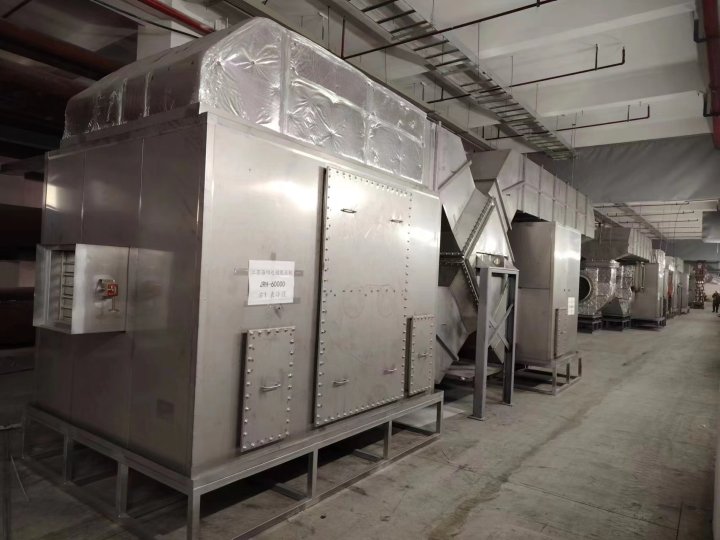

HANGZHOU, ZHEJIANG, CHINA, November 27, 2026 /EINPresswire.com/ — In industrial dry rooms, maintaining an ultra-dry production environment requires managing moisture removal and sensible temperature control through coordinated thermodynamic processes. Within a Low Dew Point Desiccant Dehumidifier Unit In Dry Rooms, post-cooling coils and reactivation heaters serve distinct, non-interchangeable functions on opposite sides of the desiccant rotor. Dryair configures its ZCH and ZCB equipment series to integrate these functions into a single, coupled air-treatment sequence that delivers stable moisture depression and precise supply temperatures.
Dew Point and Dry-Bulb Temperature Must Be Controlled Separately
In industrial psychrometrics, dew point quantifies absolute moisture content (humidity ratio in grams of moisture per kilogram of dry air), whereas dry-bulb temperature measures sensible thermal energy. A foundational principle of dry-room HVAC design is that dew point and dry-bulb temperature represent different thermodynamic properties of air. An advanced industrial dry room-such as a battery cell-assembly room-frequently demands an extremely low dew point (such as -40°C to -50°C) alongside a moderate, tightly controlled dry-bulb temperature (typically 20±1°C or 20-22°C) to protect sensitive chemistry while ensuring operator safety.
Because these two variables are governed by different physical mechanisms, they cannot be controlled by a single actuator. Moisture removal is achieved through desiccant adsorption across the rotating wheel, while temperature regulation requires sensible heat exchange via cooling and heating coils. Conflating these two control targets leads to operational instability, excessive energy use, and temperature swings in the controlled space.
The Unit Works as Two Coupled Air Streams
A low-dew-point desiccant dehumidifier unit operates through the continuous interaction of two isolated air streams: the process air stream and the reactivation air stream.
Process Air Stream: Process air (a mixture of return air from the dry room and fresh outdoor makeup air) enters the unit, passes through preliminary filtration and cooling coils, and flows through the process sector of the rotating desiccant wheel. The desiccant media adsorbs moisture, discharging an ultra-dry air stream toward the dry room.
Reactivation Air Stream: Simultaneously, an isolated reactivation fan draws an independent stream of air across a reactivation heater, elevating its temperature. This heated reactivation air passes through the regeneration sector of the rotor, stripping the adsorbed moisture from the desiccant matrix and exhausting it outside the building as warm, humid air.
In Dryair’s ZCH equipment, standard configurations incorporate cooling coils, silica-gel or molecular-sieve desiccant rotors, process and reactivation fans, a reactivation heater, and microcomputer controls. In larger ZCB combined systems, this core sequence is expanded with pre-coolers, blend coolers, post-coolers, heating coils, multi-stage filtration, and PLC automation.
Post-Cooling Conditions the Dry Air After Moisture Removal
The engineering purpose of post-cooling is sensible heat removal, not moisture extraction. Because desiccant adsorption is an inherently exothermic process that converts latent heat of vaporization into sensible heat, air leaves the desiccant rotor significantly warmer than when it entered. Furthermore, residual heat from the hot regeneration sector transfers conductively through the rotor matrix into the process sector.
Post-cooling coils positioned immediately downstream of the desiccant rotor perform the critical task of sensible heat removal. The post-cooler uses chilled water or direct-expansion refrigerant to cool the ultra-dry air to the specified room supply temperature (typically 15-25°C) before it enters the distribution ductwork. Post-cooling does not generate the low dew point, nor does it regenerate the rotor; its sole engineering purpose is thermal regulation, ensuring that the process air enters the room at the required dry-bulb setpoint.
Reactivation Restores the Rotor’s Adsorption Capacity
While post-cooling manages the process air, reactivation governs the moisture-desorption cycle on the regeneration side of the rotor. Without adequate reactivation heat, the desiccant matrix becomes saturated, its vapor pressure rises, and its ability to adsorb moisture from the process air collapses.
Dryair’s standard ZCH configurations incorporate electric reactivation heaters or steam heat exchangers to match available plant utilities. For lower regeneration energy use, the ZCR Series pairs refrigeration waste heat with a lithium-chloride and silica-gel low-temperature-regeneration composite rotor based on Dryair’s 2009 invention patent 200910154107.0. Unlike a standard silica-gel wheel requiring approximately 130°C reactivation air in conventional units within the same product family, the ZCR composite rotor regenerates at approximately 60°C. This heat-recovery approach lowers utility power demand while sustaining effective desiccant regeneration.
The Control Sequence Must Coordinate Both Loops
Sustaining continuous dry-room stability requires dynamic coordination between the process cooling loop and the reactivation heating loop. If reactivation heating is throttled excessively, rotor moisture-removal capacity declines, causing supply dew points to rise. Conversely, if reactivation heat is increased without adjusting post-cooling capacity, supply-air dry-bulb temperatures will drift above allowable room limits.
An integrated control sequence establishes interlocks between fans, heaters, and cooling valves. The reactivation heater must be interlocked with the reactivation fan and rotor rotation sensor to prevent overheating. Meanwhile, the post-cooling control valve modulates in response to leaving-air dry-bulb temperature sensors, while reactivation energy modulates based on moisture load or return dew-point feedback. Establishing this multi-loop control hierarchy prevents thermal hunting and ensures consistent environmental conditions.
Project Conditions Determine Which Modules Are Necessary
Determining the exact combination of pre-cooling, post-cooling, heating, and reactivation hardware depends on the specific project boundary conditions. In a historical battery manufacturing project for BYD, Dryair deployed a ZCH-6000S low-dew-point desiccant dehumidifier unit configured to maintain an environmental target of 20±1°C with a dew point of Td ≤ -50°C. This project underscores why dry-bulb temperature and dew point must be treated as independent design criteria when selecting and configuring equipment modules.
When preparing a project specification, engineering teams should establish:
Entering air temperature and moisture content across seasonal extremes.
Required supply-air dry-bulb temperature and supply-air dew point.
Process airflow rate and external static pressure requirements.
Available site utilities, including chilled water temperature and available electrical or steam capacity.
Specific heat-recovery opportunities, such as refrigeration waste heat for low-temperature reactivation.
By defining these parameters, engineers can work with Dryair to select the appropriate ZCH, ZCB, or ZCR configuration to satisfy both thermal and moisture-removal requirements. To learn more about equipment configurations, visit the Dryair official website.
Dryair
Dryair
email us here
Legal Disclaimer:
EIN Presswire provides this news content “as is” without warranty of any kind. We do not accept any responsibility or liability
for the accuracy, content, images, videos, licenses, completeness, legality, or reliability of the information contained in this
article. If you have any complaints or copyright issues related to this article, kindly contact the author above.

Media gallery