The Food segment retained approximately 27.0% share in 2025, led by snack pouches-to-rigid conversion trends and dairy cup demand.
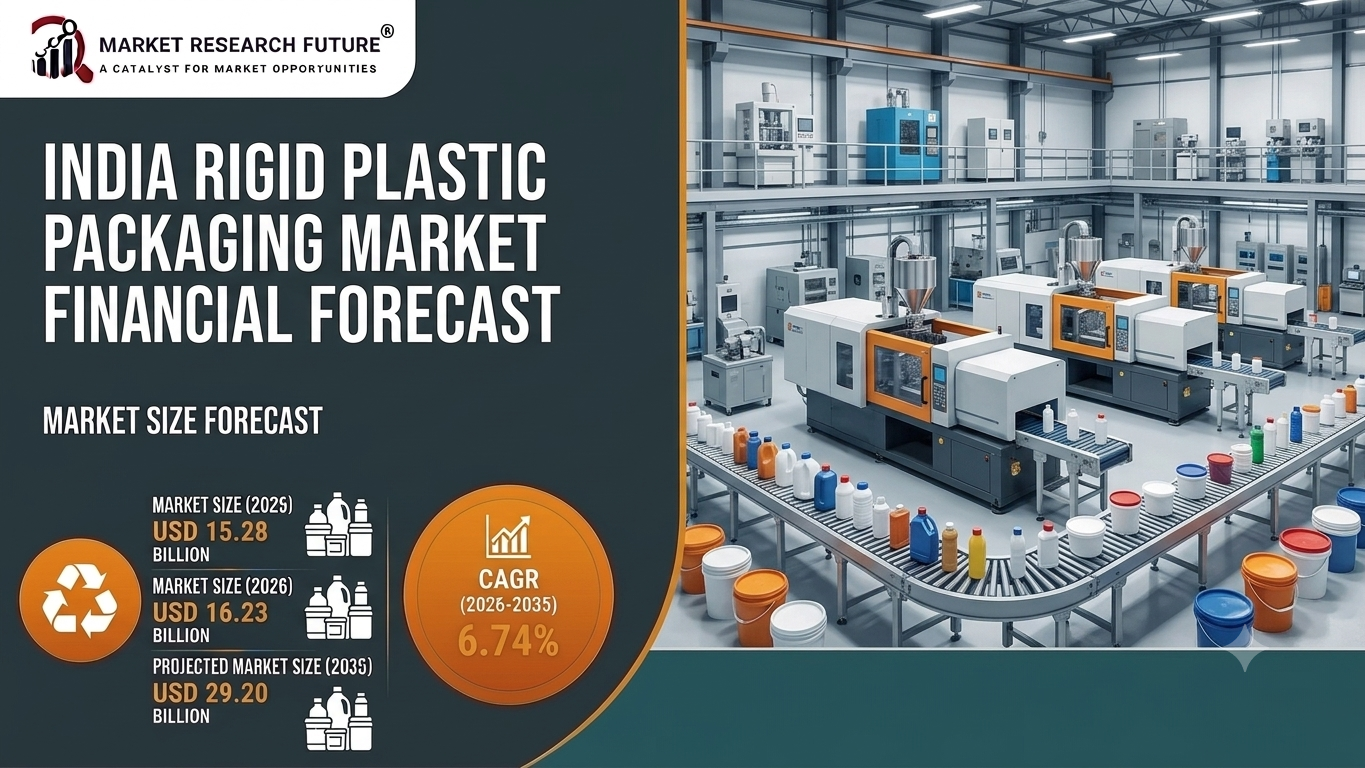
MAHARASHTRA, INDIA, August 27, 2026 /EINPresswire.com/ — The India Rigid Plastic Packaging Market is entering a strong growth phase as packaged food consumption, pharmaceutical production, beverages, personal care products, e-commerce, and cold-chain infrastructure continue to expand across the country. Rigid plastic packaging includes bottles, jars, trays, containers, caps, closures, crates, drums, and other formats manufactured using materials such as PET, PE, and PP. These products provide durability, lightweight performance, barrier protection, convenience, and efficient transportation. According to Market Research Future, the market was valued at USD 15.28 billion in 2025 and is projected to increase from USD 16.23 billion in 2026 to USD 29.20 billion by 2035, registering a 6.74% CAGR during 2026–2035.
Packaged Food Consumption Accelerates Market Growth
Increasing penetration of packaged food is one of the major growth drivers for the India Rigid Plastic Packaging Market. Changing lifestyles, urbanization, rising disposable incomes, and the expansion of organized retail are encouraging consumers to purchase packaged snacks, dairy products, ready-to-eat meals, beverages, and other convenience foods.
Rigid plastic formats provide manufacturers with several advantages, including product protection, stackability, durability, resealability, and compatibility with automated filling systems. Bottles, tubs, containers, and trays are therefore becoming increasingly important across India’s food-processing industry.
The expansion of packaged food into Tier-2 and Tier-3 cities is creating another major opportunity. As organized retail, quick-commerce services, and modern distribution networks expand beyond major metropolitan areas, demand for standardized packaging formats is expected to increase.
PET Maintains a Leading Position
By resin type, the market includes Polyethylene Terephthalate (PET), Polyethylene (PE), Polypropylene (PP), and Others. PET held approximately 35.5% of the market in 2025, supported by strong demand for beverage bottles and edible-oil containers.
PET is widely used because of its transparency, strength-to-weight ratio, barrier properties, and established recycling infrastructure. Beverage manufacturers continue to rely heavily on PET bottles for packaged water, carbonated drinks, juices, and other liquid products.
However, Polypropylene (PP) is projected to be the fastest-growing resin, with an estimated 8.05% CAGR through 2035. Its heat resistance and chemical stability make it particularly attractive for food containers, microwavable packaging, pharmaceutical applications, and other products requiring dimensional stability.
Get Report Sample Copy with TOC: https://www.marketresearchfuture.com/sample_request/20707
Bottles and Jars Lead Product Demand
By product type, the India Rigid Plastic Packaging Market is segmented into Bottles & Jars, Trays & Containers, Caps & Closures, and Others.
Bottles & Jars represented approximately 37.8% of the market in 2025, making them the leading product category. Their widespread use across beverages, personal care, pharmaceuticals, food products, and household applications provides a broad demand base.
Bottles are also benefiting from lightweighting initiatives. Manufacturers are increasingly reducing resin consumption while maintaining required strength and top-load performance. This helps packaging producers lower material costs and improve sustainability.
Trays & Containers are expected to grow at a 7.25% CAGR through 2035, supported by ready-to-eat meals, fresh-produce packaging, bakery products, food delivery, and convenience-oriented consumption.
Food Industry Remains a Major End-Use Sector
The Food segment accounted for approximately 27.0% of the market in 2025, making it the leading end-use industry. Demand comes from snacks, dairy products, confectionery, processed foods, sauces, edible oils, and other packaged food categories.
India’s food-processing sector is undergoing significant transformation as consumers increasingly prefer branded and conveniently packaged products. Rigid packaging offers protection against contamination and physical damage while supporting longer distribution networks.
Food manufacturers are also adopting packaging formats designed for portion control, microwave use, resealing, and improved shelf presentation. These requirements are creating opportunities for specialized rigid containers and trays.
Pharmaceutical Packaging Emerges as a High-Growth Opportunity
Pharmaceuticals represent one of the fastest-growing end-use industries in India’s rigid plastic packaging sector. The market report projects pharmaceutical packaging to expand at an 8.77% CAGR from 2026 to 2035.
India’s large pharmaceutical manufacturing base creates substantial demand for bottles, containers, closures, blister-related rigid components, and other specialized packaging formats.
Pharmaceutical packaging requires strict quality control, dimensional consistency, chemical compatibility, and protection against contamination. The expansion of healthcare infrastructure, medicine production, vaccines, and cold-chain distribution is expected to strengthen demand.
The growing adoption of unit-dose formats and traceability requirements is also encouraging converters to invest in higher-precision manufacturing systems.
Cold-Chain Expansion Creates New Packaging Demand
The expansion of India’s cold-chain infrastructure is opening another important growth avenue. Food and pharmaceutical products increasingly require temperature-controlled transportation and storage.
Rigid plastic packaging such as HDPE crates, PET containers, PP dairy cups, and specialized containers can provide the durability required for repeated handling and temperature variations.
Investment in pack houses, refrigerated transportation, warehouses, and distribution facilities is expected to increase demand for reusable and durable rigid packaging solutions.
This trend is particularly relevant to dairy, fresh produce, meat, seafood, vaccines, and other temperature-sensitive products.
Purchase Now: https://www.marketresearchfuture.com/checkout?currency=one_user-USD&report_id=20707
Extrusion Dominates Production Processes
By production process, Extrusion is the leading technology, accounting for approximately 73.2% of the market in 2025. Extrusion remains important for high-volume production of sheets, profiles, containers, and other rigid packaging components.
The process provides manufacturers with high production efficiency and cost advantages, making it suitable for large-scale packaging operations.
At the same time, Injection Molding is projected to record a 6.10% CAGR through 2035. The technology is increasingly being adopted for caps, closures, thin-wall containers, and precision components.
Advances in high-cavitation molds and automated quality-control systems are allowing manufacturers to improve cycle times, dimensional consistency, and material efficiency.
Lightweighting Becomes a Strategic Priority
Lightweighting is becoming increasingly important as packaging manufacturers seek to reduce material consumption, transportation costs, and environmental impacts.
Advances in resin engineering, mold design, and manufacturing processes allow converters to produce thinner packaging without compromising essential performance characteristics.
PET bottles, for example, can be redesigned with reduced material weight while retaining required strength and pressure resistance. Similar developments are taking place across PP containers, closures, trays, and other rigid formats.
Lightweighting can also help brand owners meet sustainability goals while reducing overall packaging costs.
Recycled Content Supports Circular Packaging
Environmental concerns surrounding plastic waste are encouraging the industry to increase the use of recycled materials. Food-grade recycled PET, or rPET, is becoming increasingly important for beverage and food packaging.
The development of India’s collection and recycling infrastructure can improve access to suitable post-consumer feedstock. Converters investing in advanced recycling and decontamination technologies can capture opportunities in premium recycled-content packaging.
The market is also moving toward mono-material packaging, where compatible resin structures simplify sorting and recycling. These solutions can help manufacturers respond to Extended Producer Responsibility requirements and brand-owner sustainability commitments.
Smart Packaging Creates Emerging Opportunities
Connected packaging is another emerging opportunity within the India Rigid Plastic Packaging Market. QR codes, NFC tags, serialization technologies, and other digital features can be integrated into rigid containers to improve traceability, authentication, inventory management, and consumer engagement.
Pharmaceutical manufacturers have a particularly strong need for track-and-trace solutions because product authenticity and supply-chain visibility are critical.
Premium consumer products can also use connected packaging to provide consumers with product information, authenticity verification, loyalty programs, and digital experiences.
As digital infrastructure improves, smart packaging is expected to become increasingly relevant across healthcare, food, beverages, and personal care.
Raw Material Price Volatility Remains a Challenge
Raw material pricing remains one of the major challenges facing packaging converters. PET, PP, PE, and other polymers are influenced by fluctuations in crude-oil prices, feedstock availability, production capacity, and global trade conditions.
Changes in resin prices can directly affect manufacturing margins, particularly for converters operating under fixed-price contracts.
Smaller manufacturers may face greater pressure because they have less purchasing power and limited ability to absorb short-term price increases. Long-term supply agreements, material optimization, and increased recycled-content use can help companies manage some of these pressures.
EPR Regulations Influence Industry Strategies
Extended Producer Responsibility is significantly influencing packaging design and procurement decisions in India. Brand owners and packaging manufacturers are increasingly required to consider the collection, recycling, and end-of-life management of plastic packaging.
This regulatory environment is encouraging greater investment in recyclable materials, recycled content, traceability, and waste-collection systems.
While compliance can increase operational costs, it also creates opportunities for companies that develop efficient recycling systems and packaging solutions designed for circularity.
Report Summary: https://www.marketresearchfuture.com/reports/india-rigid-plastic-packaging-market-20707
West India Leads Regional Demand
West India accounts for approximately 34% of the India Rigid Plastic Packaging Market, making it the country’s leading regional market. Maharashtra and Gujarat are important contributors because of their strong food-processing, pharmaceutical, petrochemical, and consumer-goods industries.
Maharashtra benefits from major pharmaceutical and food-processing clusters, while Gujarat’s petrochemical infrastructure provides access to polymer feedstocks and supports large-scale packaging manufacturing.
South India is the fastest-growing region, projected to expand at approximately 7.8% CAGR through 2035. Cold-chain investment, food processing, pharmaceutical manufacturing, and strong consumer demand in states such as Karnataka and Tamil Nadu are supporting regional growth.
North India also represents an important market, supported by dairy production, e-commerce fulfillment, food processing, and expanding consumer markets.
Tier-2 and Tier-3 Cities Offer Untapped Potential
The expansion of organized retail and digital commerce into smaller Indian cities represents a major long-term opportunity. Consumers in Tier-2 and Tier-3 locations are increasingly purchasing packaged food, beverages, personal care products, and household goods.
This shift is increasing the need for standardized bottles, containers, jars, closures, and trays.
Local production facilities can provide converters with logistics advantages by reducing transportation distances and improving delivery times. Regional manufacturing hubs could therefore become increasingly important as packaging demand spreads beyond metropolitan markets.
Competitive Landscape
The India Rigid Plastic Packaging Market includes major companies such as Manjushree Technopack, Uflex Limited, Time Technoplast Limited, Supreme Industries Limited, Mold-Tek Packaging Limited, ALPLA Group, Amcor plc, Berry Global Group, Pearl Polymers Limited, Parekhplast India Limited, and Jindal Poly Films Limited.
Competition is increasingly focused on production capacity, lightweight packaging, recycled-content solutions, automation, customization, quality certifications, and sustainability.
Leading converters are investing in advanced injection molding, blow molding, extrusion, thermoforming, and recycling technologies. Capacity expansion and strategic acquisitions are also helping companies strengthen their geographic presence and product portfolios.
Related Report
Rigid Plastic Packaging Market https://www.marketresearchfuture.com/reports/rigid-plastic-packaging-market-4973
Plastic Packaging Market https://www.marketresearchfuture.com/reports/plastic-packaging-market-1688
Compostable Plastic Packaging Market https://www.marketresearchfuture.com/reports/compostable-plastic-packaging-market-12361
plastic packaging film market https://www.marketresearchfuture.com/reports/plastic-packaging-film-market-37341
molded plastic packaging market https://www.marketresearchfuture.com/reports/molded-plastic-packaging-market-28865
transparent plastic packaging market https://www.marketresearchfuture.com/reports/transparent-plastic-packaging-market-38568
Market Research Future
Market Research Future
+1 855-661-4441
email us here
Legal Disclaimer:
EIN Presswire provides this news content “as is” without warranty of any kind. We do not accept any responsibility or liability
for the accuracy, content, images, videos, licenses, completeness, legality, or reliability of the information contained in this
article. If you have any complaints or copyright issues related to this article, kindly contact the author above.

Media gallery